An Insight to Conducting a Technical and Economic Feasibility Study for Manufacturing Plants
Establishing a manufacturing plant is a significant investment that requires more than identifying a market opportunity, purchasing equipment, and securing a suitable facility. A project that appears commercially attractive may become financially unsustainable when actual production costs, equipment limitations, utility requirements, raw material availability, regulatory obligations, and operational constraints are properly evaluated.
This is where a technical and economic feasibility study becomes essential. It provides a structured assessment of whether a proposed manufacturing project can be successfully designed, constructed, commissioned, and operated at an acceptable cost and level of profitability.
A well-executed feasibility study answers two fundamental questions: Can the proposed manufacturing plant be technically implemented, and does the investment make economic sense?
These questions must be evaluated together because technical decisions directly influence capital expenditure, operating costs, production capacity, product quality, and ultimately the financial performance of the business.
1. Define the Project Scope and Manufacturing Requirements
The first stage is to establish exactly what the proposed manufacturing plant is expected to produce, its intended production capacity, operating schedule, and target market.
For instance, establishing a sachet water production facility is fundamentally different from developing a bottled water plant, even though both involve water treatment and packaging. Similarly, a detergent manufacturing facility may require different mixing systems, chemical storage arrangements, process controls and packaging technologies depending on its formulations and production volumes.
The project definition should establish the product specifications, production capacity, number of operating shifts, expected annual production volume, required product variants and anticipated future expansion.
It is also important to distinguish between installed capacity and actual saleable production. A plant designed to manufacture 10,000 units per hour will not necessarily deliver that output continuously. Equipment efficiency, planned maintenance, changeovers, process losses, labour availability, and market demand all influence actual production.
Consequently, the feasibility study should establish a realistic production basis rather than relying exclusively on equipment manufacturers' advertised capacities.
2. Conduct a Technical Assessment of the Manufacturing Process
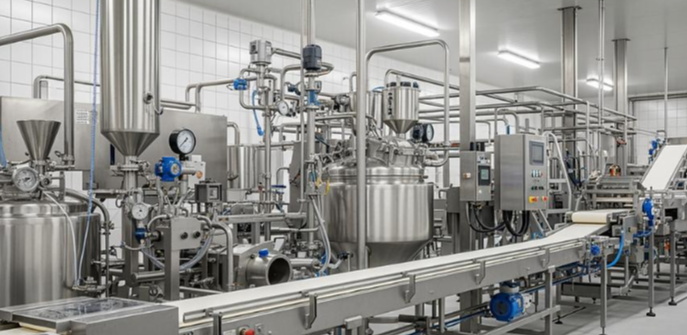
The technical assessment determines whether the proposed manufacturing process can achieve the required production volume, product specifications, quality standards, and operational reliability.
This begins with selecting an appropriate manufacturing technology and developing a preliminary process design. Engineers should examine the sequence of production operations, material transformation requirements, equipment configuration, process conditions, and associated utility systems.
A Process Flow Diagram (PFD) is particularly useful at this stage because it illustrates the principal equipment, material streams and process relationships. More detailed engineering development may subsequently require piping and instrumentation diagrams (P&IDs), equipment specifications, preliminary layouts and utility distribution designs.
Equipment selection must consider more than purchase price and nominal capacity. Factors such as operating efficiency, maintenance requirements, availability of spare parts, energy consumption, automation level, compatibility with local operating conditions, and supplier technical support can significantly influence the long-term performance of the facility.
For example, selecting an undersized industrial pump may restrict production throughput, while an oversized pump may increase energy consumption and operating costs. Similarly, an inadequately designed heat exchanger may fail to deliver the required thermal duty, affecting production rates and product quality.
The technical assessment should also examine process flexibility. A plant that can accommodate changes in product formulations, packaging sizes, raw material characteristics or production volumes may offer greater long-term commercial value than one designed around a narrowly defined operating condition.
3. Evaluate Raw Materials, Utilities and Infrastructure Requirements
A manufacturing plant is only as reliable as the resources supporting its operation. The feasibility study must therefore establish whether the required raw materials, utilities and infrastructure are available in sufficient quantities, at acceptable costs and with consistent quality.
Raw material assessment should consider local availability, supplier reliability, transportation costs, quality specifications, storage requirements, seasonal variations and exposure to foreign exchange fluctuations where imported materials are involved.
Utility requirements should be calculated using the proposed production capacity and process design. These typically include electrical power, water, steam, compressed air, cooling water, fuel, and wastewater treatment, depending on the nature of the manufacturing operation.
For example, a manufacturing facility may have sufficient electrical supply for its nominal equipment load but still experience operational difficulties because of voltage fluctuations, inadequate backup generation or insufficient distribution capacity.
Water-intensive industries require particular attention to water source reliability, treatment requirements, storage capacity, and wastewater disposal. Chemical manufacturing facilities must additionally consider chemical storage compatibility, ventilation, containment and appropriate safety systems.
The assessment should translate these requirements into preliminary engineering specifications, including utility loads, storage capacities, distribution arrangements and infrastructure investments.
4. Determine the Plant Layout and Production Capacity
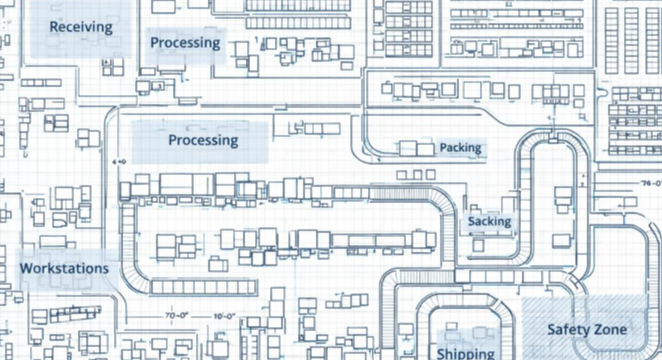
Plant layout is an important engineering consideration because it affects material handling, production flow, labour productivity, safety, maintenance accessibility and future expansion.
A properly developed layout should minimise unnecessary movement of materials and personnel while maintaining appropriate separation between raw material storage, processing, packaging, finished goods storage and dispatch operations.
The arrangement should also account for equipment maintenance access, emergency exits, fire protection, ventilation, drainage, utility distribution and regulatory requirements.
Production capacity should be evaluated against the entire manufacturing system rather than the capacity of an individual machine. In an interconnected production line, the equipment with the lowest effective throughput may become the bottleneck and restrict overall plant output.
A useful starting point is to estimate annual production capacity using:
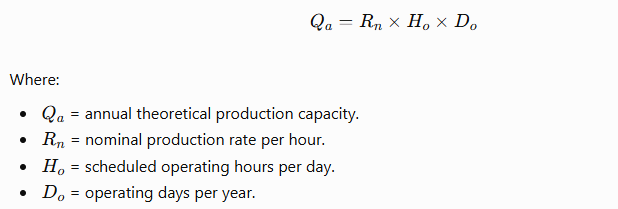 Actual saleable production should subsequently account for availability, performance and quality losses:

This provides a more realistic basis for determining production volumes, revenue projections and equipment requirements.
5. Establish Capital Expenditure (CAPEX)
Capital expenditure represents the total investment required to develop the manufacturing facility and make it ready for commercial operation.
A common mistake in manufacturing investment is to equate plant establishment cost with the purchase price of production equipment. In practice, machinery may represent only one component of the overall project investment.
The CAPEX assessment should include land acquisition or lease costs, civil and structural works, building construction, production equipment, utility systems, installation, instrumentation, electrical works, material handling systems, laboratory facilities, safety installations, engineering and project management costs. Importation-related expenses, including freight, insurance, customs duties, clearing charges and inland transportation, should also be considered where applicable.
Pre-operational expenditure is another important consideration. These costs may include equipment testing, commissioning, initial raw materials, personnel recruitment, training, regulatory approvals, and trial production.
The total installed project cost can be expressed as:
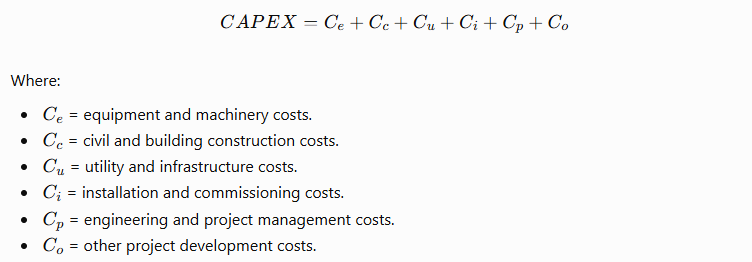 The estimate should be supported by preliminary engineering, supplier quotations, comparable project costs, and clearly stated assumptions. Contingency allowances should reflect the maturity of the design and the uncertainty surrounding project execution.
6. Estimate Operating Expenditure (OPEX)
While CAPEX determines the initial investment, operating expenditure determines how much it costs to keep the manufacturing plant running.
OPEX should be developed around the anticipated production volume and operating conditions rather than relying on broad industry averages.
Typical expenditure includes raw materials, packaging materials, direct labour, electricity, water, fuel, maintenance, spare parts, quality testing, waste disposal, insurance, logistics and administrative overheads.
For a chemical manufacturing plant, raw materials may constitute a significant proportion of total production costs. In contrast, an energy-intensive manufacturing operation may be particularly sensitive to electricity and fuel prices.
It is therefore useful to calculate the unit manufacturing cost:
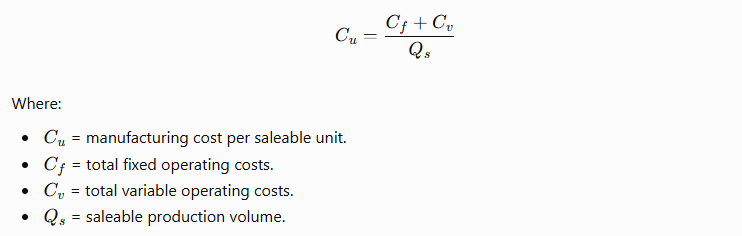
The calculation helps determine whether the proposed product can be manufactured competitively at the expected selling price. Importantly, the feasibility study should distinguish between manufacturing costs and total business costs. Distribution, marketing, financing charges, taxes, and other commercial expenses may need to be included in the wider financial model.
7. Evaluate Market Demand, Revenue and Commercial Viability
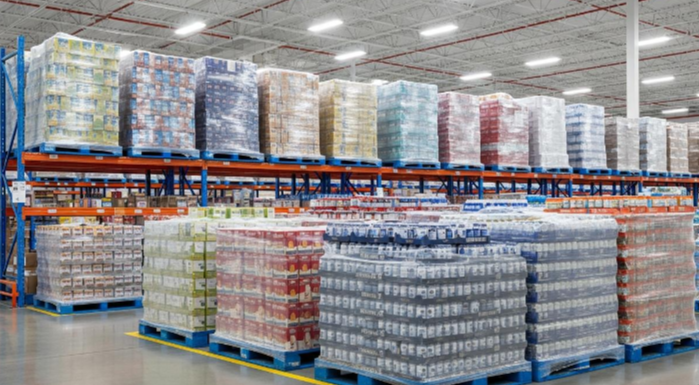
A technically sound manufacturing plant is not necessarily a commercially viable investment. The facility must produce goods for which there is sufficient demand at prices that can sustain profitable operations.
Market assessment should examine the target customer base, existing competitors, prevailing market prices, distribution channels, product differentiation, expected market growth, and barriers to entry.
The projected sales volume must be consistent with realistic market absorption. It is generally inappropriate to assume that a newly established factory will immediately sell its entire installed production capacity.
Revenue projections can be developed using:
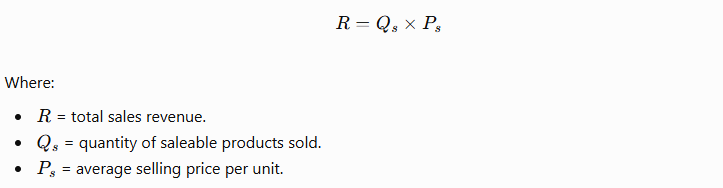
The projected revenue should be evaluated against manufacturing costs, operating expenses, distribution costs, taxes, and financing obligations. The analysis should also consider whether the business can compete with established manufacturers, imported alternatives and other products serving the same market.
8. Perform Financial Feasibility and Investment Appraisal
Financial analysis integrates the technical and commercial findings into a structured assessment of investment performance. The objective is to determine whether the expected cash flows justify the initial investment and associated business risks. Several financial indicators are particularly useful.
Payback Period
The payback period estimates how long it takes for a project to recover its initial investment from net cash inflows.\[ Payback=\frac{Initial\ Investment}{Annual\ Net\ Cash\ Inflow} \]For example, consider a manufacturing project requiring an initial investment of ₦250 million and generating an estimated annual net cash inflow of ₦75 million.

This simplified calculation suggests a payback period of approximately 3.33 years. A proper project appraisal should use the projected year-by-year cash flows, particularly where production and profitability are expected to increase gradually.
Net Present Value (NPV)
NPV evaluates the present value of future project cash flows relative to the initial investment, accounting for the time value of money.
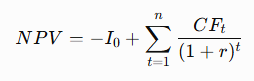 .

A positive NPV indicates that the project is expected to generate value above the selected discount rate, subject to the reliability of the underlying assumptions.
Internal Rate of Return (IRR)
IRR is the discount rate at which the project's NPV equals zero. It provides an estimate of the project's expected return and can be compared with the investor's required rate of return or cost of capital.
Break-Even Analysis
Break-even analysis establishes the production or sales volume at which total revenue equals total costs.

This is particularly useful for determining the minimum production and sales volume required to avoid operating losses.
These indicators should be assessed collectively. A project with a short payback period may still have a relatively poor long-term return, while a project with attractive NPV may expose the investor to significant cash flow pressure during its initial operating years.
9. Assess Risks, Regulatory Requirements and Environmental Considerations
Every manufacturing project carries technical, financial, operational, commercial and regulatory risks. A feasibility study should identify these risks before substantial capital is committed. Technical risks may include equipment failure, process instability, inadequate production capacity, and inconsistent product quality. Commercial risks may arise from fluctuating raw material prices, weak demand, competition, and supply chain disruptions. Financial risks include foreign exchange exposure, interest rate changes, inflation and insufficient working capital.
Environmental and safety considerations must also be incorporated into the preliminary design. Depending on the manufacturing sector, these may involve wastewater treatment, air emissions, solid waste management, chemical handling, fire protection, occupational exposure and emergency response systems.
In Nigeria, regulatory considerations may include relevant requirements from the Standards Organisation of Nigeria (SON), National Agency for Food and Drug Administration and Control (NAFDAC), Federal Ministry of Environment and applicable state and local authorities. The precise approvals depend on the product, facility and proposed activities.
Where relevant, engineering assessments should incorporate applicable standards such as ISO management system standards, ASME equipment design requirements, API standards and appropriate environmental and safety regulations. A project should not be considered fully feasible merely because the equipment can be purchased and installed. It must also be capable of operating safely, legally, and sustainably.
10. Develop an Integrated Project Implementation Plan
The final stage is to translate the feasibility findings into a practical implementation strategy. This should establish the proposed project execution sequence, engineering deliverables, procurement strategy, construction requirements, installation activities, commissioning procedures and expected commercial start-up date.
A typical implementation framework progresses from feasibility approval to detailed engineering, procurement, construction, mechanical completion, pre-commissioning, commissioning, performance testing and commercial operation. The project schedule should account for equipment manufacturing and delivery lead times, importation, construction activities, utility connections, regulatory approvals, and personnel training.
The study should also identify the working capital required to sustain operations during the initial production period. This is important because a factory can be fully constructed and commissioned yet struggle to operate. After all, insufficient funds are available to purchase raw materials, pay employees, and meet routine operating expenses before customer payments are received.
The outcome should be a coherent project development roadmap supported by preliminary engineering, cost estimates, financial projections, risk assessments, and clearly defined implementation milestones.
Turning Manufacturing Opportunities into Viable Industrial Investments
A successful manufacturing investment begins long before the first machine is installed. It begins with a thorough understanding of the proposed process, the resources required to operate it, the market it will serve, and the financial implications of bringing the facility into operation.
Technical and economic feasibility studies provide the foundation for making these decisions. They help investors avoid inappropriate equipment selection, underestimated project costs, unrealistic production forecasts, inadequate utility provisions, and financial assumptions that could undermine the entire investment. More importantly, they establish a connection between engineering design and commercial performance. Equipment capacity influences production output; process efficiency influences operating costs; product quality influences market acceptance; and capital allocation influences the project's financial returns.
For this reason, manufacturing plant development should never be approached as simply a machinery procurement exercise. It should be treated as an integrated engineering, financial and business development project.
At Delflow Industries, we recognise that successful manufacturing begins with sound engineering decisions. Through process engineering, plant design, equipment selection, manufacturing solutions and technical consultancy, we support organisations in translating manufacturing concepts into practical and commercially viable industrial facilities.
Whether you are planning a water treatment and packaging facility, a chemical manufacturing plant, a flexible packaging operation, or another industrial production facility, a properly conducted feasibility study is an essential first step towards a successful investment.
Planning a manufacturing project? Engage Delflow Industries for professional engineering guidance, plant development support, and manufacturing solutions tailored to your project requirements.