Designing a Commercial Water Treatment Plant: From Raw Water Analysis to Final Product
Designing a commercial water treatment plant involves considerably more than selecting filters, pumps, and disinfection equipment. It requires a systematic understanding of the raw water source, the intended product-water quality, treatment technology, production capacity, operating costs, and regulatory requirements.
A plant designed for treating relatively clean groundwater may be entirely unsuitable for a surface-water source containing high turbidity, organic matter, algae, and seasonal contaminants. Similarly, water intended for bottled or sachet drinking-water production may require a different treatment arrangement from water intended for industrial boilers, cooling systems or general process applications.
The fundamental objective is to develop a treatment system that consistently converts available raw water into water that meets its intended quality specifications, at the required production rate and at an economically sustainable operating cost.
This article examines the major engineering considerations involved in designing a commercial water treatment plant, from initial raw water assessment to final product delivery.
1. Establishing the Design Basis
The first step is to establish exactly what the plant is expected to produce and how much water it must deliver. A commercial water treatment plant should not be designed around an assumed treatment capacity or a generic equipment package. Its design must originate from the intended market, customer requirements, operating schedule, and product-water specifications.
For example, a plant supplying drinking water for commercial distribution may require a treatment train incorporating filtration, membrane treatment where necessary, disinfection and hygienic storage. An industrial water treatment plant may instead require softening, demineralisation, reverse osmosis or other specialised treatment processes depending on the application. The design basis should establish the raw water source, required production capacity, operating hours, daily demand, peak demand, product-water quality, storage requirements, available utilities, site conditions and applicable regulatory requirements.
Production capacity must also distinguish between raw water intake, treatment capacity, and actual saleable product-water output. These are not necessarily the same. For a plant operating for a defined number of hours per day, the required production rate can be estimated as:
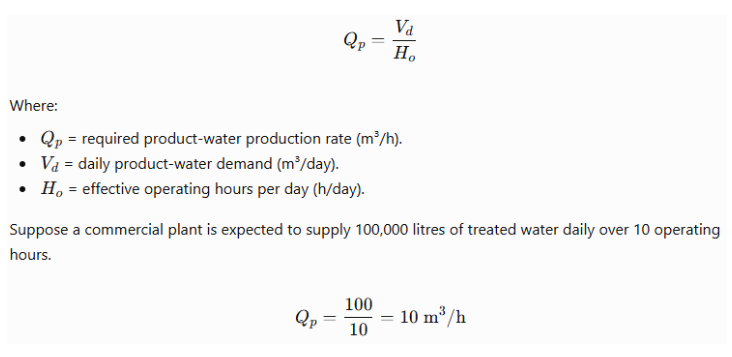
This represents the required average product-water production rate, not necessarily the raw water feed rate. Additional allowance must be made for treatment losses, backwashing, reject streams, downtime, and other operational requirements.
2. Raw Water Analysis: The Foundation of Treatment Design
Raw water analysis is arguably the most important stage of the entire design process. It determines the contaminants that must be removed, the treatment technologies required, and the operating conditions under which the plant will function. A common engineering mistake is to select a treatment system before obtaining reliable laboratory results. This can result in unnecessary equipment, inadequate treatment capacity, premature membrane fouling, excessive chemical consumption, or failure to achieve the required product-water quality.
The water source may be a borehole, river, reservoir, lake, municipal supply or harvested rainwater. Each source has different characteristics and potential treatment challenges. For groundwater, important parameters may include iron, manganese, hardness, dissolved solids, chloride, sulphate, nitrate, fluoride, pH and microbiological indicators. Surface water may additionally contain significant suspended solids, turbidity, colour, natural organic matter, algae and seasonal microbial contamination. The analytical programme should therefore be developed around the source characteristics and intended use of the treated water.
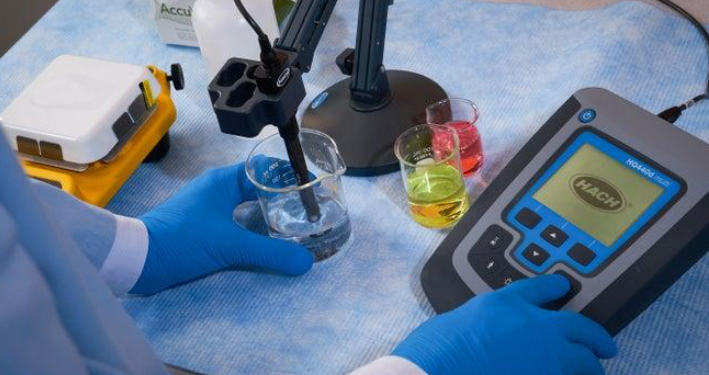
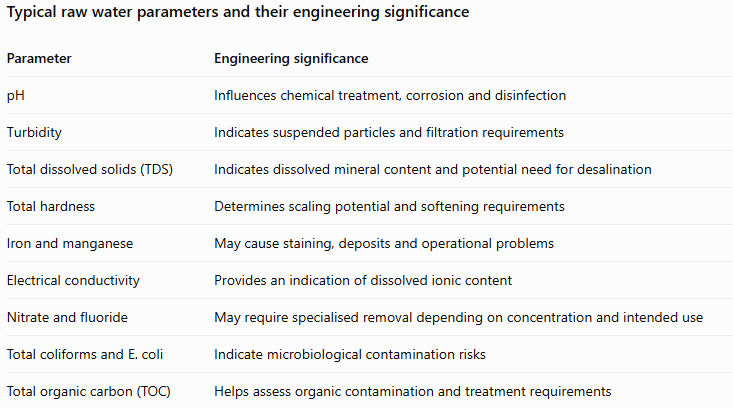
The results should be evaluated against the relevant drinking-water or industrial-water specifications. For potable water, the WHO Guidelines for Drinking-water Quality provide an important international reference, alongside applicable Nigerian requirements, including relevant NAFDAC and Standards Organisation of Nigeria (SON) provisions. Where the raw water source is seasonal, a single sample may not adequately represent its characteristics. Sampling should consider seasonal variation, particularly for surface water and boreholes affected by changing groundwater conditions.
The engineer should also consider whether the analytical results are internally consistent. For example, electrical conductivity and TDS should show a reasonable relationship, while alkalinity, hardness, and ionic composition should be examined together when evaluating scaling potential. The objective is not simply to obtain a laboratory report. It is to translate the results into a reliable engineering design basis.
3. Selecting the Appropriate Treatment Process
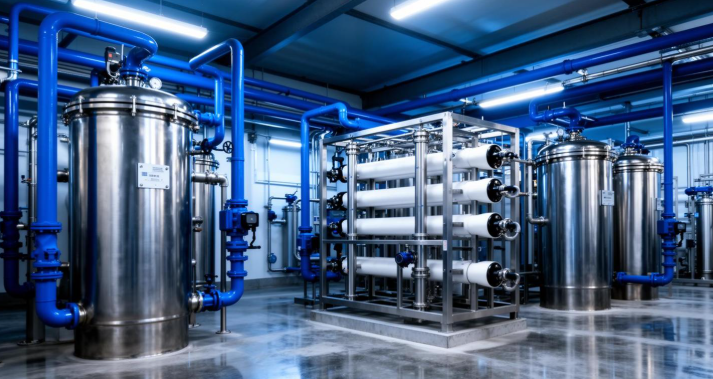
Once the raw water characteristics and final product specifications are established, the treatment process can be selected. There is no universally suitable water treatment configuration. The treatment train must be developed according to the contaminants present, their concentrations, the required product quality, and the economics of the selected technology. A typical commercial drinking-water treatment plant may include some or all of the following stages:
Raw water intake and preliminary treatment
The intake system transfers raw water from the source to the treatment facility. It may incorporate intake pumps, strainers, screening equipment, raw water storage, and flow measurement. For surface-water sources, preliminary screening can remove large debris, vegetation, and other materials that could damage downstream equipment. Raw water storage can also provide operational flexibility by separating source-water availability from treatment-plant operating requirements.
Coagulation and flocculation
Where raw water contains colloidal particles, turbidity and certain forms of colour, coagulation and flocculation may be required. Coagulants such as aluminium sulphate or ferric salts destabilise suspended particles, allowing them to aggregate into larger flocs that can subsequently be removed by sedimentation or filtration. The appropriate coagulant and dosage should be established through laboratory testing, particularly jar testing. The required chemical dosage is influenced by raw water characteristics, temperature, pH, alkalinity and the nature of the suspended matter.
Sedimentation or clarification
Clarification separates suspended solids and coagulated flocs from water through gravity settling or other separation mechanisms.The design should consider hydraulic loading, detention time, solids loading, sludge collection and removal arrangements.For commercial plants treating relatively turbid surface water, clarification can substantially reduce the solids loading on downstream filtration systems.
Multimedia filtration
Multimedia filters typically use layers of different filtration media to remove suspended particles and residual flocs.Common media include anthracite, silica sand and supporting gravel, although the actual arrangement depends on the filter design.Filter sizing should consider the required filtration rate, available filter area, solids loading, backwash frequency and water quality entering the filters.The filters must also be designed with adequate backwashing arrangements. A filtration system that cannot be effectively backwashed will gradually experience increased pressure drop and deteriorating performance.
Activated carbon filtration
Granular activated carbon (GAC) is used to adsorb certain organic compounds, improve taste and odour, and remove residual oxidants where appropriate.Its effectiveness depends on contaminant characteristics, carbon properties, contact time and operating conditions.Activated carbon should not be regarded as a universal contaminant-removal solution. It does not reliably remove all dissolved salts, inorganic contaminants or microbiological hazards.
Water softening
Where hardness is excessive, water softening may be required to reduce calcium and magnesium concentrations.A common approach is ion exchange using sodium-form cation exchange resin. Calcium and magnesium ions are exchanged for sodium ions, reducing hardness and limiting scale formation.The system requires appropriate regeneration arrangements, salt storage, brine preparation, and wastewater management.
Reverse osmosis
Reverse osmosis (RO) is one of the most widely applied technologies for removing dissolved salts and a broad range of dissolved contaminants from water.
It uses pressure to force water through a semi-permeable membrane, producing a lower-salinity permeate stream and a concentrated reject stream.RO is particularly useful where groundwater or surface water contains elevated dissolved solids or where a high-purity product is required.
However, RO should not automatically be included in every water treatment plant. Its selection must be justified by raw water analysis and the final product-water specification. Membrane design must consider feed-water quality, recovery, operating pressure, temperature, scaling potential, fouling, pretreatment requirements, and concentrate disposal.
The recovery ratio is expressed as:
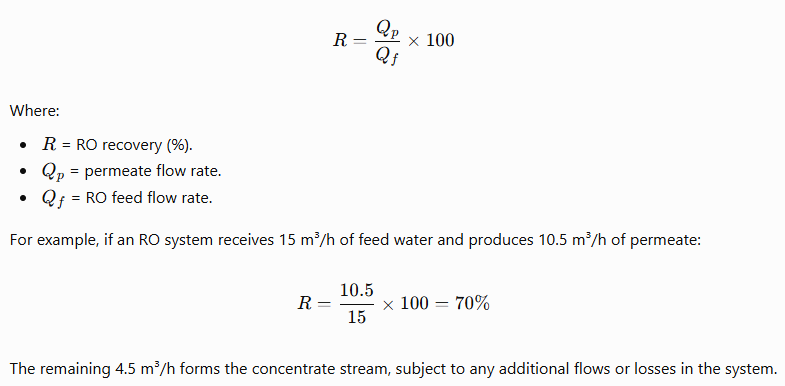
A high recovery ratio may reduce water wastage, but it can increase the concentration of dissolved minerals in the reject stream and raise the risk of membrane scaling. The optimum recovery must therefore be established through proper membrane projection and water chemistry assessment.
4. Disinfection and Final Product Protection
Producing visually clear water does not necessarily mean that the water is microbiologically safe. Disinfection is a critical barrier against pathogenic microorganisms and must be incorporated into the treatment strategy according to the intended use. Common disinfection technologies include:
- Chlorination using sodium hypochlorite or other suitable chlorine-based chemicals.
- Ultraviolet (UV) disinfection.
- Ozone treatment.
Each technology has different operating characteristics. Chlorination can provide a residual disinfectant within distribution and storage systems, provided appropriate contact time and residual control are maintained. UV treatment can provide effective inactivation of susceptible microorganisms but does not leave a lasting disinfectant residual. Ozone is a powerful oxidant and disinfectant, but its application requires careful process design and control of potential by-products.
For potable water, disinfection should be supported by adequate upstream filtration and a validated treatment strategy. Turbidity, organic matter, contact time, disinfectant concentration, and water chemistry can influence performance. Where RO is used, the permeate may require remineralisation or pH adjustment before final disinfection and distribution, depending on its quality and intended use.
The final product-water storage tank should be designed to prevent contamination. Its construction material, internal surfaces, access arrangements, vents, overflow protection and cleaning provisions are important considerations.
For bottled or sachet drinking-water production, additional hygienic controls are required around the filling and packaging areas. Treatment does not end at the outlet of the filtration system; the entire product-handling arrangement must preserve the water quality achieved.
5. Developing the Process Flow Diagram and Plant Configuration
After selecting the treatment technologies, the engineer develops the Process Flow Diagram (PFD). The PFD defines the principal equipment, process streams, flow directions, and major operating parameters. It provides the basis for equipment sizing, process calculations, utility requirements, and subsequent detailed engineering.
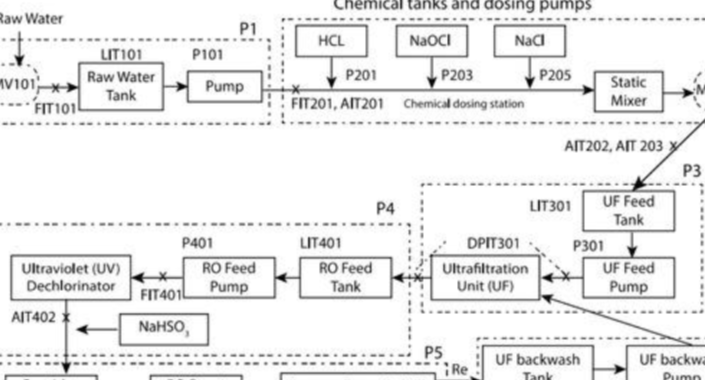
This is a conceptual process sequence, not a universal treatment prescription. For example, a plant treating low-turbidity borehole water may not need coagulation and clarification, while a high-TDS groundwater source may require a more extensive pretreatment arrangement before RO.
The PFD should be developed into a Piping and Instrumentation Diagram (P&ID), which defines piping, valves, instruments, control loops, equipment connections, safety devices, drains, vents, and operating interfaces. The design should also incorporate appropriate instrumentation for monitoring flow, pressure, differential pressure, pH, conductivity, turbidity, and disinfectant residual, as applicable.
6. Equipment Sizing and Hydraulic Design
The next stage involves translating the process requirements into correctly sized equipment. Equipment selection should be based on hydraulic, mechanical, chemical, and operational requirements rather than simply choosing commercially available units with attractive specifications. For a commercial plant, major equipment may include raw water pumps, chemical dosing pumps, pressure filters, softeners, RO high-pressure pumps, membrane vessels, UV systems, storage tanks, transfer pumps, instrumentation and control panels.
Pump selection
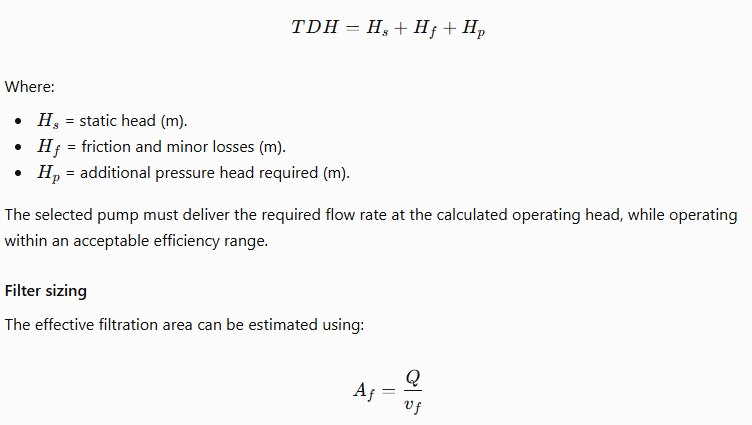
Pump selection requires an accurate estimate of the total dynamic head (TDH), which includes static head, friction losses, and pressure requirements at the discharge point.A simplified expression is:
 The actual dosing pump capacity must account for the concentration of the prepared chemical solution, solution density, dosing turndown, calibration and operating flexibility.
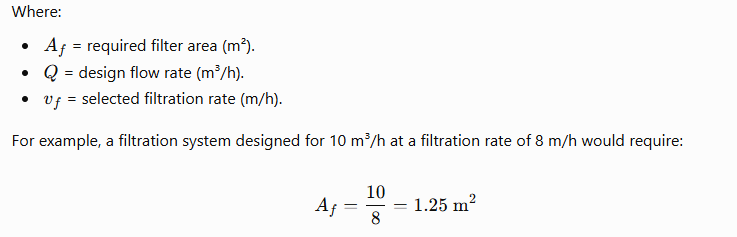
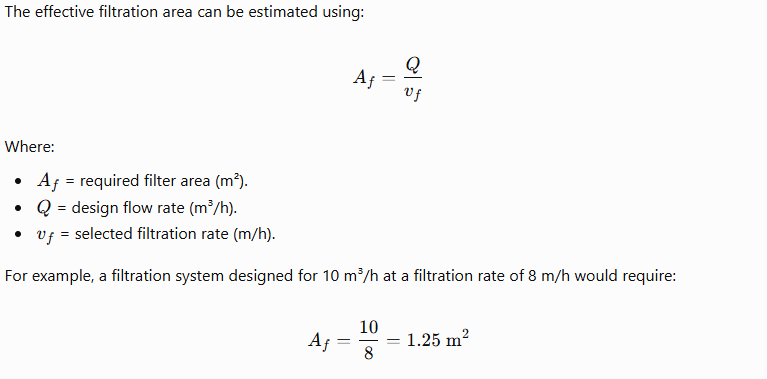
This is the theoretical effective filtration area. Final equipment selection must also consider vessel geometry, media depth, loading distribution, pressure drop, backwashing, and redundancy.
Chemical dosing
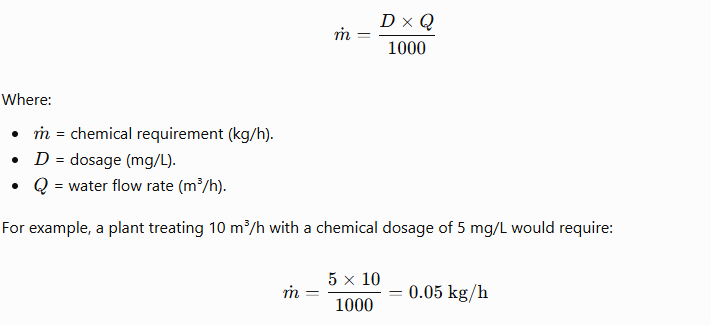
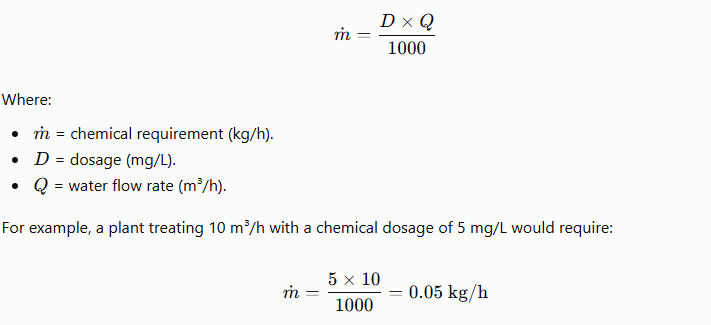
Chemical dosing systems must be sized based on the required dosage, process flow rate and chemical concentration.A simplified mass-based dosing relationship is:
The selected pump must deliver the required flow rate at the calculated operating head, while operating within an acceptable efficiency range.
Filter sizing
The effective filtration area can be estimated using:
Click Here to Download Readymade Engineering/Process Equipment Design, Continuous Improvement, Quality, Production, ISO 9001, ISO 14001, ISO 22000, ISO 45001, FSSC 22000, HACCP, Food Safety, Integrated Management Systems (IMS), Lean Six Sigma, Project, Maintenance and Compliance Management etc. Kits.
7. Plant Layout, Utilities and Infrastructure
An efficient water treatment plant is not simply a collection of interconnected equipment. Its physical arrangement must support safe operation, maintenance, hygiene and future expansion.The layout should provide appropriate separation between raw water handling, chemical storage, treatment equipment, treated-water storage and product packaging areas.Where potable water is produced, particular attention should be given to preventing cross-contamination between untreated and treated water. Chemical handling areas should also be appropriately separated from hygienic product-handling areas.The design should consider:
- Adequate access for equipment inspection and maintenance.
- Drainage and wastewater collection.
- Electrical distribution and backup power.
- Ventilation and lighting.
- Chemical storage and containment.
- Backwash and reject-water management.
- Safe access to tanks, filters and pressure vessels.
- Space for future capacity expansion.
In locations where power supply is unreliable, backup generation or alternative energy arrangements may be necessary. The electrical design should account for pump starting currents, motor loads, control systems and critical process equipment.A well-designed layout reduces unnecessary piping, pressure losses, maintenance difficulties and operational inefficiencies.
8. Product-Water Quality Assurance and Regulatory Compliance
The quality of the final product must be defined before the plant is commissioned.For potable water, the product should comply with the applicable drinking-water requirements, including microbiological, physical and chemical quality criteria.The monitoring programme should be developed around the risks associated with the source water and the selected treatment process.
Typical monitoring points include raw water intake, post-clarification, post-filtration, RO permeate, post-disinfection and final storage or distribution. For an RO-based system, conductivity or TDS can provide useful indications of membrane performance. For filtration systems, turbidity and differential pressure help identify deterioration in performance. Disinfectant residual and microbiological testing are important for verifying the effectiveness of the final disinfection and storage arrangements.
A commercial potable-water plant in Nigeria should consider applicable requirements from NAFDAC, SON and relevant environmental and water authorities, depending on the business model, product type, location and regulatory classification. Compliance should not be treated as an activity undertaken only after construction. Regulatory requirements should influence the design basis, materials of construction, process selection, quality-control arrangements, sampling provisions, documentation and operational procedures from the beginning.
9. Waste Management and Environmental Considerations
Water treatment generates waste streams that must be properly managed. These may include filter backwash water, sludge from clarification, softener regeneration brine, RO concentrate, spent filter media and chemical cleaning solutions. The volume and characteristics of these streams depend on the selected treatment processes and operating conditions. For example, an RO plant operating at 70% recovery will produce a concentrate stream equivalent to approximately 30% of its feed flow, assuming the stated recovery basis and neglecting other losses.
This stream cannot automatically be discharged into the environment without evaluating its chemical composition and applicable discharge requirements. Similarly, sludge from coagulation and clarification may require thickening, dewatering, and appropriate disposal. Wastewater management should therefore be included in the original plant design rather than treated as an afterthought. Poorly planned waste handling can create environmental liabilities and increase the overall cost of operating the facility.
10. Estimating CAPEX, OPEX and Commercial Viability
A technically sound treatment plant must also be economically viable. Capital expenditure (CAPEX) includes the cost of process equipment, pumps, tanks, piping, electrical systems, instrumentation, civil works, installation, engineering, commissioning and other project-related costs. Operating expenditure (OPEX) includes electricity, treatment chemicals, membrane replacement, filter media replacement, labour, laboratory testing, maintenance, packaging materials where applicable, wastewater disposal and other recurring costs.
The cost of producing a unit volume of treated water can be estimated as:
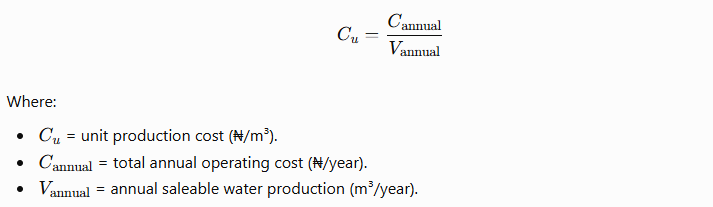
For a commercial operation, this calculation should use saleable product volume rather than simply the raw water feed volume. This ensures that reject water, treatment losses, downtime, and other production inefficiencies are reflected in the cost. Energy consumption is another important consideration, particularly for RO plants and systems involving high-pressure pumping.
Specific energy consumption can be expressed as:
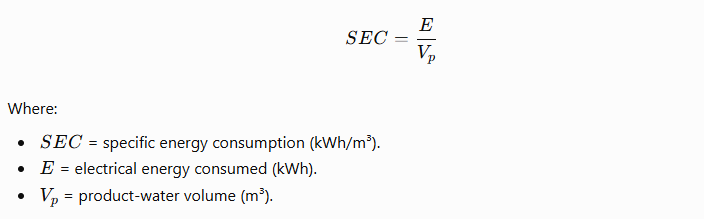
This metric provides a useful basis for comparing plant performance, identifying energy losses and evaluating opportunities for optimisation. For a commercial drinking-water operation, the financial assessment should also include packaging, distribution, sales margins, working capital and expected market demand. A technically efficient plant may still be commercially unsuccessful if the cost of producing and distributing the final product exceeds what the market can sustainably support.
11. Automation, Instrumentation and Operational Reliability
Modern commercial water treatment plants increasingly rely on instrumentation and automation to maintain stable operating conditions and reduce operator dependency. A well-designed control system can monitor process conditions, initiate equipment sequences, generate alarms, and protect critical equipment against abnormal operating conditions.
For example, a treatment plant may incorporate automatic filter backwashing based on differential pressure or elapsed operating time, low-pressure and high-pressure protection for RO systems, tank-level control for transfer pumps, and automatic shutdown under specified abnormal conditions. The RO system may also incorporate conductivity monitoring to identify deterioration in permeate quality, while flow measurement can be used to monitor production, recovery, and water losses.
However, automation does not eliminate the need for competent operators. The plant must still have clearly documented operating procedures, chemical handling instructions, maintenance schedules, sampling plans and emergency response arrangements.
Reliability also requires consideration of standby pumps, critical spare parts, equipment redundancy and the availability of local technical support. The design should consider how the plant will be operated and maintained over its entire lifecycle, not just how it will perform during initial commissioning.
12. Installation, Commissioning and Performance Validation
The final stage of plant development is converting the engineering design into a functioning treatment facility. This involves equipment procurement, fabrication, civil construction, installation, piping, electrical works, instrumentation, control-system integration and pre-commissioning inspections.
Commissioning should be conducted systematically, beginning with mechanical completion checks, flushing, pressure testing, electrical verification, instrument calibration, and functional testing. The plant can then undergo wet commissioning using actual raw water, allowing the engineer to establish operating conditions and evaluate the performance of individual treatment units.
For RO systems, commissioning may involve verification of feed pressure, permeate flow, concentrate flow, recovery, conductivity, and membrane performance. For filtration systems, the engineer should assess filtration performance, pressure drop, backwashing effectiveness, and water quality after filtration.The final product must undergo appropriate laboratory testing to demonstrate that it meets the required specifications.
Performance validation should examine more than whether water is flowing through the system. It should establish whether the plant consistently delivers the required product quality and production capacity at acceptable operating costs. A commissioning report should document operating parameters, test results, equipment performance, outstanding issues, operator training, and recommended maintenance requirements.
Designing for Quality, Reliability and Commercial Performance
Designing a commercial water treatment plant requires an integrated engineering approach that connects water chemistry, process selection, hydraulic design, equipment sizing, automation, environmental management, and commercial evaluation. The most effective treatment system is not necessarily the one with the largest number of filtration stages or the most expensive equipment. It is the system that removes the identified contaminants reliably, produces water that meets the required specifications, operates efficiently and remains economically sustainable throughout its service life.
The process should always begin with reliable raw water analysis and a clearly defined product-water specification. From there, the treatment train, equipment configuration, plant capacity and operating strategy can be developed on a sound engineering basis. For businesses considering a new water treatment facility or upgrading an existing plant, proper engineering design can make a significant difference to product quality, operating costs, equipment reliability and long-term profitability.
At Delflow Industries, we approach water treatment projects from the perspective of complete process engineering—from raw water assessment and treatment technology selection to plant design, equipment integration, installation, and commissioning. Our objective is to develop practical, reliable, and commercially viable water treatment solutions that meet the specific requirements of each project.
Planning a commercial water treatment plant? Engage Delflow to help translate your water quality requirements and production targets into an engineered treatment solution.